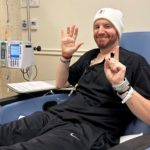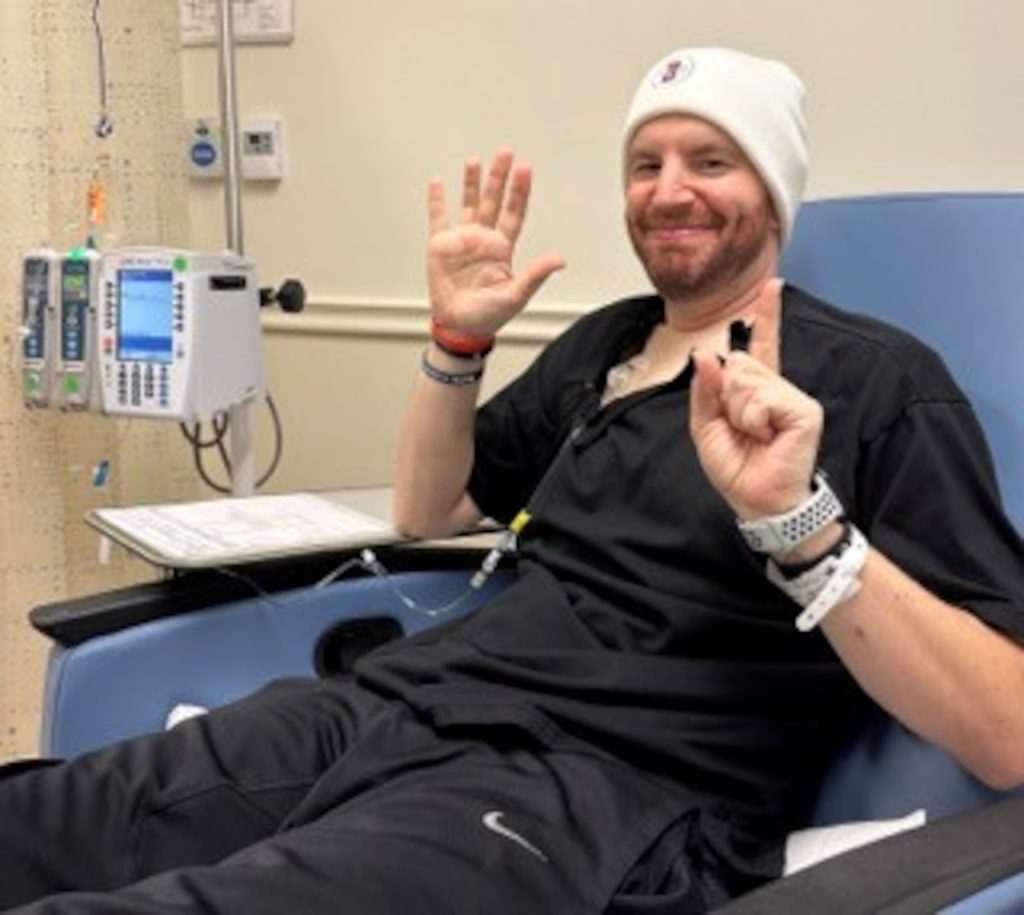


CLEVELAND, Ohio — On any given day, Luke Williams can be found dropping his kids off at practice, running errands or coaching his daughter’s basketball and softball teams. To most, he looks like a typical stay-at-home dad. But behind that routine is a relentless fight against stage 4 colorectal cancer — one he’s managing with the help of a cutting-edge treatment.
Luke Williams, 44, of North Ridgeville, was diagnosed in December 2022 at just 41 years old after a colonoscopy revealed a tumor roughly the size of a softball, along with four large tumors on his liver.
“The doctor obviously knew immediately that I had colon cancer,” Luke Williams said. “The size of the tumor that was there.”
He underwent radiation and multiple rounds of chemotherapy, followed by major surgery in June 2023 to remove the tumors. But the cancer repeatedly returned to his liver, prompting doctors at University Hospitals Seidman Cancer Center to pursue a more targeted option: a hepatic arterial infusion, or HAI, pump.
Implanted under his skin in June 2024, the hockey-puck-sized device delivers chemotherapy directly to the liver — where his cancer is concentrated — instead of throughout the entire body.
“It feeds chemo directly to my liver,” Luke Williams said. “At least with this pump, I’ve been able to coach my daughter’s basketball team and softball team and just kind of have as normal a life as possible.”
The pump is refilled every two weeks, alternating between chemotherapy and saline to give his body time to recover. Compared to traditional chemotherapy, the targeted approach reduces widespread side effects and improves quality of life.
Luke Williams’ care team, including radiation oncologist Dr. Lauren Henke, helped guide the shift in treatment.
“[Henke] was like, ‘I want to do something different and see what we can do,’” Luke Williams said. “She has always been at the forefront of leading the team.”
Doctors say innovations like the HAI pump are part of a broader shift in treating advanced colorectal cancer, particularly when the disease has spread to the liver.
Dr. Melissa Lumish of UH Seidman Cancer Center said the treatment reflects a broader, team-based approach and ongoing research efforts and is a promising option for many patients who are fit to undergo surgery and have cancer that has only spread to the liver.
“This highlights the forward-thinking, multidisciplinary care that we provide for young patients with colorectal cancer,” Lumish said. “In addition, this is an opportunity for us to study and learn more about patients who benefit from this therapy. It will also allow us to be a part of multicenter trials that are ongoing.”
Another advancement at University Hospitals is adaptive radiation therapy, which allows doctors to adjust radiation plans in real time as a patient’s anatomy changes.
“Adaptive radiation is basically to reshape and remake the radiation plan in the moment, live while the patient is on the treatment table,” Henke said.
While treatment options are improving, doctors warn of a troubling trend: colorectal cancer is increasingly affecting younger adults.
“What we’re seeing now is that the rates are rising really sharply in people who are less than 50 years old,” Henke said. “Those rates since the ’90s have essentially doubled and are expected to continue to rise.”
Once considered a disease primarily affecting older adults, colorectal cancer is now commonly diagnosed in younger patients.
“It used to be an oddity,” Henke said. “Now it’s something I see every week, if not every day.”
The shift has already prompted national health authorities to lower the recommended screening age from 50 to 45. Even so, many eligible adults are not getting screened. Henke said only about one-third of people between 45 and 50 undergo recommended screening.
“Colorectal cancer is essentially preventable or can be caught at really early stages through screening,” she said. “When we find precancerous polyps, the colonoscopy itself becomes the therapy.”
Luke Williams’ experience underscores the importance of early detection. At 41, he was below the recommended screening age at the time, and his doctor had to push his insurance company to approve the colonoscopy that ultimately led to his diagnosis.
“He had to fight hard for them to get me a colonoscopy,” Luke Williams said. “He was my biggest champion.”
Luke Williams believes that decision likely saved his life.
“If I would have waited even a few more months, I might not be here,” he said.
Now, he’s advocating for screening to begin even earlier.
“I hope that it goes down to 40 or even 35 sooner rather than later,” he said.
New data from the American Cancer Society shows the growing impact of the disease. In 2026, an estimated 158,850 new cases of colorectal cancer will be diagnosed in the United States, and more than 55,000 people are expected to die from it.
Colorectal cancer is now the leading cause of cancer-related death among adults under 50, with incidence rates in younger adults rising by as much as 3% per year. Nearly half of all new cases now occur in people under 65.
Common symptoms include changes in bowel habits, rectal bleeding or blood in the stool, abdominal pain, gas and cramping.
Researchers say more than half of colorectal cancer cases are linked to modifiable risk factors, including smoking, poor diet, alcohol use, physical inactivity and obesity. Still, screening remains one of the most effective tools for prevention and early detection.
Despite that, about three in four colorectal cancer cases in adults under 50 are diagnosed at advanced stages, when treatment is more complex.
Locally, the impact is also significant. In Cuyahoga County, colorectal cancer accounted for about 8% of new cancer cases from 2018 to 2022 and was the second leading cause of cancer deaths, according to the Ohio Department of Health. During that time, 63% of cases were diagnosed at a late stage, while just 29% were caught early.
Doctors say early diagnosis can dramatically improve outcomes.
For Luke Williams, the fight continues. He has experienced short periods of remission — the longest lasting about three months — but remains focused on making the most of each day with his wife of 10 years, Amy Williams, their 13-year-old daughter, Morgan Williams, and 7-year-old son, Carter Williams.
“We’ve got one life, and we’ve got one body, and you’ve got to take care of both,” Luke Williams said. “Even on the toughest days, if you can get 1% better than you were the day before, that makes a world of difference.”